Showing posts with label Book Review. Show all posts

Friday, February 10, 2023

What I'm Reading Now

Sarah Winman, Still Life

I saw this recommended on one of the book blogs I follow, I don't remember whose, but thank you, thank you. This is an amazing book. 

I recall the book blogger saying it was a story of love, found families, and E.M. Forster, which was enough to get me to hunt it down; the Forster is mostly influence, though he does make an actual appearance. 

The novel starts on the outskirts of Florence, Italy in the middle of WWII, with a young British soldier and a sixty-year old British art historian, who may or may not be a spy. Ulysses Temper is with the Eighth Army, the Allied forces fighting to take Italy back from the Axis; Evelyn Skinner is here to help salvage the art of Florence which has been hidden or lost during the various invasions. They have a brief encounter as their two missions intersect, a magical encounter, made magic -- Winman hints -- at least in part because of where they are, there in the hills above Florence, and because of what they are doing, locating and retrieving the art of Florence. One work specifically -- Pontormo's The Deposition from the Cross -- runs through the novel, wielding influence on all the characters.


Ulysses and Evelyn don't meet again until the 1970s, but the novel follows their lives and the lives of the characters who are their friends and family, through the decades until they meet up again. Ulysses returns to England, where he lives with all his friends and neighbors as well as his wife and his wife's child (conceived with an American soldier who then abandons her) in a fairly grim bit of London; but when the kid, as he calls his wife's child, is five, Ulysses inherits an apartment in Florence, and moves with the kid and one of his friends, Cress, to live in Italy thereafter. 

The writing here is amazing, fully immersive, with immense narrative pull. The contrast between the grim, damp, fetid slum in England and the impoverished but beautiful square in Florence is wonderful, and Winman's ability to make us see and believe in the transformative power of art is just as wonderful. Plus the characters are great. This is my new favorite writer, though sadly my library only has two of her books, this one and one another (already requested!). I will have to hunt the other down in used bookstore.


David Mitchell, The Bone Clocks 

I liked this the best of any of Mitchell's books I've read. Each section of the book is set in a different time and follows the same group of characters, starting in the 1980s and continuing into the future, after climate change has wrecked the world (though Iceland is doing pretty well). We follow secondary characters as well as main characters as they age through the decades, and as the world changes around them. 

There's some science fantasy elements involving a cabal of immortals having a war throughout time, which I enjoyed; but the characters and the use of place and time are the best part of this. There's a semi-happy ending. I liked this one a lot, and it taught me a new word: pandiculate.


Claire Keegan, Foster

I read Keegan's earlier short-story-published-as-a-book, and liked it well enough, so I picked this one up when I saw it at the library. The earlier one, Small Things Like these, worked well as a novella/long short story. This one is even shorter and really would have been improved with some more length. It's the story of an Irish girl, maybe eight years old? Maybe a little younger. It's never made clear, except she's school age, and her mother seems to be having a child a year, with the result that this child, the oldest child, is suffering from neglect. The girl is sent off to live with her aunt and uncle, whose only child has died, and blooms there, under their care. Then she's sent home again, just after her mother's new baby is born.

The language and descriptions of mundane life on this little farm in the Irish countryside are great, as is the characters development. If this book had been four times as long as it currently is, I would have loved it. As it is, it feels truncated and rushed -- just as we settle in to enjoy the story, it's over. Disappointing. Keegan is clearly a gifted writer. Someone should tell her to slow down.


Saturday, May 29, 2021

What I'm Reading Now


I've been reading all along, but I see that I have stopped writing posts about it. Here's what I can remember reading over the past few months:


Alison Bechdel, The Secret to Superhuman Strength

I love Bechdel (source of the infamous Bechdel Test). Her first two graphic novels, Fun Home and Are You My Mother? are both brilliant. This one is also good -- we follow Bechdel, decade by decade, as she uses different sorts of exercise in an attempt to achieve enlightenment, and also has a life. As with the previous two books, her readings in the field inform her quest, so we hear a lot about other people who have tried to achieve enlightenment, and especially those who did so through physical exertion.

The art is wonderful -- the influence of Dr. Seuss is even more profound in this one -- the writing is wonderful, and the book is excellent. Are You My Mother? is still my favorite Bechdel, but this one is very much worth reading.


Martha Wells, Fugitive Telemetry

A Murderbot book. I will read anything about Murderbot that Wells publishes. This one involves a murder on Preservation Station, which Murderbot helps to solve. Lots of bots in this one. It's a novella, not a novel, but if your library is like mine, they've probably bought it.


Naomi Kritzer, Chaos on Catnet

This is the sequel to Catfishing on Catnet, which is excellent, and you should definitely read it now if you haven't already. Chaos on Catnet is a worthy sequel to that novel, set, as Kritzer notes, in the future Minneapolis she wants to live in. Me, too!

In this one, Steph and her Clowder, including CheshireCat, deal with the second AI who appeared at the end of the first book. Lots of other stuff happens too. Highly recommend, and not just because I like books about AIs.


Sarah Pinsker, We Are Satellites 

A high-concept SF novel, by which I mean it works because of the tech it speculates about -- in the near future, brain implants make it possible for everyone to multitask effectively and to hyperfocus on any given task, while also accomplishing two or three other tasks. Anyone without a brain implant thus becomes a less attractive employee, a less accomplished student, a second-class citizen.

Certain people can't get implants -- those from certain religions, or those who have some sort of brain dysfunction (like epilepsy). And of those who get the implants, a certain number have ADHD like problems. The company that created these implants covers up the problems, with long-term consequences for those suffering them. (The implants rebuild the brain with long-term use: brain plasticity for the, uh, win.)

This novel focuses around a family of four, two of whom get the implants, one who can't, and one who doesn't. The family is the best part of the novel, especially the kid with epilepsy: the two moms are well done, and the family dynamics were also good. This is a family in which you can screw up, but still stay part of the family. I don't think that gets shown enough in fiction.


Saturday, February 27, 2021

Reading Angela Thirkell

 A comment over on one of Jo Walton's reading lists reminded me of Angela Thirkell, who I used to read in those ancient days before the kid was born, and before we could buy books online, when all I had was what was available in the local library. 

Though at that time I was living in Pocatello, Idaho, and had access to both the excellent small public library there and the library at the Idaho State University, this was still not very many books. I forget how I stumbled across Thirkell, but I do remember that the first book I read by her was The Brandons. 


Between the university library and the public library, there were only six or seven Thirkell novels. I read them all, and haunted used bookstores for more when we drove down to Salt Lake City or over to Boise for a day out. To no avail -- Thirkell was at that point long out of print.

Now it seems, however, that she is being re-issued, a volume at a time, by Virago Press; and I have used up my B&N gift cards buying some. (Also our public library has three of them -- I read those first.)

Thirkell, goddaughter to J.M. Barrie and cousin of Rudyard Kipling, wrote a series of novels between 1933 and 1961 set in Anthony Trollope's Barsetshire. These are the interconnected stories of upper-class, aristocratic families who live in this fictional county. 

These might be seen as romance novels -- the key engine in every novel is at least one man and one woman (often two or three sets) who bumble around but eventually realize they love each other. Marriage follows. But really the romance is a side issue. Thirkell's true interest is the soap-opera-ish lives of her upper-class characters.

They're satirical throughout, sometimes viciously so, and give, I think, a fine picture of the worldview of the English aristocracy of the period, which to understate things can be problematic.

For instance, Thirkell despises refugees. Many of these books were written during the run-up to and the period of World War II, when England was taking in refugees from the conflict in Europe. Thirkell peoples her novels with ill-behaved, ill-mannered minor characters from invented countries, and has her upper-class heroes make a number of comments about "those" refugees coming here to take jobs from good Englishmen, while those same Englishmen have been sent to fight the war these refugees escaped.  

(Jews? What Jews? Reading Thirkell you would assume that Jews do not exist. She never mentions them, and Hitler is a villain only in that he is killing upper-class English men.)

Women also, especially in the books written after the war, are villains for taking jobs that should belong to men. The decent women feel ashamed of this, of course, though I notice they take the jobs anyway. "Bad" women, which is to say uppity women not from the right families, just take these jobs as though they have a right to them.

This includes academics. Thirkell despises women who are academics. She has several male professors and tutors as main characters, and since she writes in third person omniscient (occasionally third person authorial), we are privy to the contempt these men have for their female students and colleagues. This contempt, we are meant to understand, is not only understandable, but perfectly correct.

In August Folly, we are given one of Thirkell's most scathing characterizations, a world-famous economist who also happens to be a woman. (That she is more famous and makes more money than her husband, who is a scholar as well, but of Norse folklore, is seen as a failing on her part.) This silly creature, Mrs. Tebben, thinks she can be as rational and logical as a man, but all her attempts lead to misery and discomfort for her family -- she can't manage her cook; she forces her poor husband to work in a tiny, icy room; and she is incapable of standing up to her extremely rude son. 

Furthermore, she doesn't know the tacit rules of behavior that allow one to belong to the "right" people. In Miss Bunting, for instance, which is set in the last years of the war, Mrs. Tebben very rudely brings her own food to a tea party (and it's disgusting food, of course, since her education and her pretense at being intelligent and rational have ruined her for her proper role, housekeeping).

Luckily, however, she has a daughter, Margaret. Margaret's father is briefly saddened that they could not afford to send Margaret to a university (they did send their son), but everyone, including Margaret, sees that as the natural order of things. Margaret, because she sublimates her ambitions in a proper womanly fashion (trying to help her brother), is the salvation of the family. She has spent her energies learning to cook and manage a household, the way a good woman should. She marries a rich man's son and, we are to presume, lives happily every after.

The women characters we're supposed to approve of and applaud are those who are intelligent but subservient -- those who are too busy being wives and daughters, helping to run estates and their husband's households, to bother with going to a university. 

Problematic also is Thirkell's concept of both the working class and of those people who became wealthy after the war through such vulgar means as manufacturing and trade. 

The working class who know their place Thirkell just mocks, and fairly gently. They are comic relief, having illegitimate children and talking in dialect. Those who step out of their place -- i.e. workers who dare to start a union, or working class children who attend an Oxbridge University -- are mocked bitterly. 

Sam Adams and his daughter Heather are examples of the latter. Sam Adams is a manufacturer, a foundry owner. He is from the working class, and becomes enormously wealthy. His wealth allows him, in post-WWII England, to encroach on the circle that should properly belong only to the upper-class: Thirkell's "county" people. Everyone despises him for daring to come to tea parties and jumble sales where he is not wanted, and for giving or trying to give expensive gifts to churches and for birthday presents. 

Thirkell despises him as well. He doesn't know his place, and he doesn't understand the rules of "correct" society. He dares, for instance, in Miss Bunting, to offer a local vicar help with the church accounts. In The Brandons, Miss Morris does this same thing for the local vicar in that book, and everyone is fine with it. But when Sam Adams makes this offer, it is a high social crime which sends our upper-class characters into paroxysms of horror and outrage. 

(Similarly, Thirkell, starting in Cheerfulness Breaks In, introduces a pair of impoverished women, in the form of Miss Hampton and Miss Brent, who don't follow the rules for "proper" women. These two are meant to be read as Lesbians, but as the novels progress it becomes clear that we are to approve of these women and find them admirable. Why? Because they're "county," as Thirkell puts it elsewhere: they are upper-class and from the "right" families, even if they do dress funny and are now impoverished. If the wrong people do it, it's gauche; if "our" people do it, it's charming.)

Equally, when Sam Adams offers donations to the local churches, as he does in almost every book, this is seen as a breach of propriety. What if he wants us to dedicate a window to his wife, one vicar thinks, in horror and disgust -- I guess because Adams' wife was working class? Or maybe Sam Adams will try to influence the sort of window, and pick something tacky? It's never really made clear why these acts are so appalling. I guess if I were "county" I would just know.

Thirkell is even more vicious when it comes to Heather Adams, Sam's adolescent and then adult daughter (she grows up through the books). There are endless comments about how "large" this girl is ("She must weight 12 stone," one character comments) and how sweaty and how ugly and how badly dressed and how ill-mannered and so on. She commits one faux pas after the next, bringing, for instance, an expensive gift to a well-born friend's party (something that is admirable when another character does it, two pages earlier, this one upper-class) and not knowing what to say to her "county" schoolmates.

Heather eventually redeems herself, though: she realizes her true place and steps back into it, marrying a guy from the working class as she should, albeit one who went to Cambridge, who works at her father's foundry. Heather herself is a prodigy in math, and goes to Cambridge too, but don't worry, she doesn't try to become an academic: she also goes to work for her father, though only until she has children, when she becomes a proper supportive wife.

And all the upper-class people in these novels, with true noblesse oblige, work endlessly and tirelessly to take care of the working class in their community. Not only are they job providers (unlike Sam Adams, I guess), they perform charitable works for the hapless louts on their estates, who cannot possibly survive on their own.

And what is the reaction of those ungrateful whiners? They vote in a Labour Government, nationalize the trains and power companies and health providers which had been returning a steady 5% for all the wealthy land owners, and tax everything to death. Also, they dare to object to capitalism! And form unions! And want their kids to have orange juice!

As in Faulkner, whose Snopes take over from the benevolent and superior landed gentry of his fictional county, Thirkell, in the later novels, has Sam Adams and his ilk "taking over" England. And as with Faulkner, this is seen as a tragedy. In Faulkner, miscegenation and black people as well as "white trash" getting out of their place cause this downfall; in Thirkell, it is the corruption of the government and the losses of WWII. 

Taxation, she believes, as well as the nationalization of industries, strip the power from the hands of those who wield it properly. The right sort of people can no longer afford to have eight or nine kids each, while the lower classes have huge families (all the children illegitimate) at the expense of the taxpayers. So the upper classes are no longer being created, and those children that are born have no siblings or only one sibling. What will happen when they are sent to boarding schools, with no experience of the communal life? Alors!

Further, the state schools (run by progressives) fail to install a proper attitude in working class children. They are taught math and science and modern literature instead of religion and Latin and Greek, and what is the result? (School certificates! Thirkell expostulates. Ten-year-old genuises at math who don't know what a creche is)!

They think Jack is as good as his master, that's what. And England as it ought to be is lost. 

These are fascinating books to read if you are interested in that England which, indeed, is dead now. The soap-opera plots are engaging, and the whiplash effect of reading about a likeable, engaging character who suddenly says something disgusting never really gets old. 

Also, there is something safe about these books. It may be England in the 1930s, or England in the Blitz, or England in the grim post-War years; but the worst that is going to happen is that someone will do badly in his exams, or be rude to someone else at tea.

And they're very readable, charming and funny in the places where they aren't appalling. Thirkell is especially good with children -- I'd read them for Tony Moreland alone.

But they do show us, clearly, how the world has changed; and indeed just what the world that conservatives want us to live in actually looked like. 

Ironically, of course, if most conservatives landed in Thirkell's world, they wouldn't be the characters Thirkell lauds. They'd be the ones she despises and mocks. They're the louts who took over the world she loves.

Which is its own kind of humor, I suppose.


Sunday, April 26, 2020

What I'm Reading Now


Don Kulick, Death in the Rain Forest  

A DEATH IN THE RAINFORESTThis is a book that I got our local library to buy because I wanted to read it -- my first use of the Request a Purchase page. I'm pleased to report that it's excellent. I read it all in one night, staying up until two a.m. to do so.

Don Kulick is an anthropologist, American-born and raised, but teaching and working at Uppsala U. in Sweden. (He's also taught at NYU and the University of Chicago.) Among his other research subjects, he's studied the language use among the people of Gapun for over 30 years, documenting and analyzing the death of their language, Tayap. Tayap is only spoken in that village and is not connected to any other language in the world, or any other language in Papua New Giunea. This is a decidedly non-scholarly book about his time with the people of Gapun.

There's some linguistic detail, but it's not overwhelming (and it's the sort of thing I love). There's a lot of cultural anthropology. And there is his analysis of what killed this language in particular (and by extrapolation, maybe, other languages). Spoilers: it's not a simple answer.

Very much worth reading.

Also, have a video (you need to get past the annoying narrator -- trust me, we end up in Gapun with Don Kuklick):


Nino Cipri, Finna

This is a slender novel -- I read it in about an hour and a half -- and well-done.

Finna | Nino Cipri | MacmillanAva and Jules, who have just broken up, both work in a big-box store, LitenVald, clearly based on Ikea. But in this version of Ikea, portals open up randomly into other dimensions. Occasionally customers wander into these other dimensions, and someone has to go fetch them back.

It doesn't have to be Ava, her boss tells her. But refusing to volunteer is grounds for dismissal. (The ruthless culture of big-box management is well done here.)

Jules, on the other hand, can't wait to go.

Part of the novel is about their relationship, why it's on the rocks, whether they want to try again. Part of it is about how environment shapes people. And part is about taking the leap away from the safe into what might be a better world.

Nice writing, and a satisfying read.


Stephen King, The Outsider; If It Bleeds

I tend to avoid King, because so many of his books make me feel bad. I don't really like horror, and I don't like books that are premised on the idea that supernatural monsters are real.

On the other hand, I like 2/3rds of The Stand, a book about a pandemic, and his first book, Carrie, was a lot of fun.

And I need something to read.

So since our library had his new-ish book, The Outsider, which I hadn't read, I checked it out, and also his new book, If It Bleeds, which is really four novellas.

Two-thirds of The Outsider is pretty good. 1/2 of the stories in If It Bleeds are pretty good. If you're looking for something readable and not too awful, and you don't mind supernatural bullshit, these are not bad.


Frank Herbert, The White Plague

I read this because it's about a pandemic. Not recommended unless you like wooden characters and extensive time spent having men comment on women's breasts.

The pandemic part is also disappointing. I don't know, maybe he was trying to do political analysis instead? A Tom-Clancy type book where we get a photo-realistic glimpse of how world governments react to terrible events? (Badly, in case you're wondering.) Or maybe he was going for psychological realism?

The plague is engineered by a man whose wife and children are killed by a bomb set off by the IRA. In revenge, he engineers a plague to kill their wives. Because an eye for an eye, obviously, and women are just possessions. (To be fair, he has two women scientists as main characters, but see above re breasts.) The scientist wanted to limit the deaths to the Irish, but (as a scientist of his caliber would have expected) the plague escapes at once and begins killing women worldwide.

Meg Elison did it better, frankly. (No pun intended.)


Saturday, January 11, 2020

Reading 20th Century Science Fiction


This is a new idea I'm trying out -- I'm going to read Science Fiction written from about 1930 to about 1970 (when the Second Wave more or less began) and critique it for your reading pleasure.

Some of these books will be written by women. But I have to be able to access copies of the texts, and science fiction written by women before, well, 2010 or so, all too often is allowed to go out of print. So a larger percentage will be written by men.

I'm not going for the low-hanging fruit. These will (almost all of them) be books that have won critical acclaim, and even awards. I imagine they will all supply lots of fertile ground for our critical pleasure, though.

We'll be starting with Brain Wave, by Poul Anderson, published in 1954. This book starts with the premise of a uplift, if you know the term, for every creature with a brain that possesses a brain. An uplift is a massive gain in intelligence. There's some sciency stuff about how the uplift occurs (lots of sciency stuff in this book), which seems fairly handwavium to me.

I've never read any Poul Anderson before, so I'm new to his writing. According to Wikipedia, he started as a liberal and became a libertarian/conservative in his later years. He seems to have written a heap of SF adventure novels, though this isn't one of them.


Chapter One:

This is an effective chapter. Anderson gives us several vingettes, ranging from a rabbit in a trap to a 10 year old kid, of beings whose intelligence is increasing rapidly. The rabbit figures out how to escape from the trap; the kid invents calculus. We're interested.

Chapter Two: 

More vingettes, but we focus on the main character, a physicist named Peter Corinth. He suddenly understands how to solve a major problem that has been plaguing him. He works for the Rossman Institute, which seems to be an NGO of sorts, dedicated to solving technological problems, with the aim of helping industry. (Rossman's industry, mainly.) Cornith has been working on a way to analyze the structures of crystals. He explains all this to his wife, Sheila, in tedious detail.

The wife, Sheila, like all the women in this book, makes me wince. Sheila is -- at least before the change -- stupid. Sweet and pretty, but dumb as a rock. Why has Peter Corinth, who is a certified genius, who worked on the Manhattan project, who makes his living doing super-genius physics, why has he married someone who is just barely bright enough to wash dishes?

I mean, I guess because women are all stupid, so what else was he going to do?

In this chapter, we get interplay between Peter and Sheila, in which she demonstrates that she knows nothing about Greek mythology, and worships Peter, though she doesn't understand a single thing he's saying.

As for Peter, he's very fond of his stupid wife:

She was kind and merry and beautiful, and she could cook -- but she was nothing of an intellectual....He had sometimes thought she lived in a child's world, with nothing very well known, but all of it bright and strange.

We get Sheila's point of view after Peter leaves for work. She's delighted to be an "ordinary" housewife.

Her friends before had always been ready for a good laugh at the shibboleth-ridden boredom that was bourgeois existence, but when you got right down to it, they had only traded one routine and one set of catchwords for another, and seemed to have lost something of reality in the bargain.

This is Sheila after she's been uplifted, and she immediately stops and wonders why she's thinking such complex things. So not like her! She starts to sit down a read a mystery novel (now that the dishes are done), but then frowns and goes to pick up a "real" book instead, a well-worn one that belongs to Pete -- Lucky Jim.

Sheila sets the tone for the (very few) other women we're going to meet. Even the single working woman we encounter, Helga, who works at the Rossman Institute, isn't a scientist. She's a secretary. Useful, but only as a support for the real people men.

First Pete Corinth has to encounter our other main character, Felix Mandelbaum (it's nice to see a Jew), in the elevator. Felix has also figured out a difficult problem, though his has to do with how to organize labor unions. They note this odd coincidence, and then separate as they leave the building.

Pete rides the subway to work at the Rossman Institute, meanwhile ruminating over his past -- his work on the Manhattan Project, his useless time trying to organize scientists after the way, his brief period in academia. What's the point, he thinks, and then, like Sheila, wonders why he's thinking all this.

He also thinks about the Rossman Institute, and how it's the only way to get science done. Governments and universities can't do science, Pete knows: the former because governments interfere with scientists and the latter because of all the politics and back-biting. (The government seemed to have done science with the Manhattan Project, but okay.)

The elevator man in the Institute is also uplifted. He and Pete have a conversation which leads to Pete suggesting the elevator man should go back to college.

Pete works in his lab. He gets a call from Lewis, who has noticed something strange in his lab. They go to lunch to talk about it, and Helga shows up.

She was a tall, rangy, handsome woman, her long blonde hair drawn tightly around her poised head, but something in her manner -- an impersonal energy, an aloofness, perhaps only the unfeminine crispness of speech and dress -- made her less attractive than she could have been.

Worse, we soon find out that Helga can't keep a man. Horrors! Not only not as attractive to men as she could be, she also has not been able to marry. What a terrible fate!

Helga tells them that the institute's computer (yes, there's only one, this is 1954) isn't working right, and also that everyone in the institute has suddenly had "bright ideas" that they want to try out, via the computer and other technology, so everything is a mess.

Lewis tells them about his own lab, where he's finding that the neurones (nerve cells) he's been studying all of a sudden are reacting much faster than before.

This is the key to the uplift: electromagnetic transmitters transmit more quickly, including those in the brain. So everyone is thinking faster, and apparently this makes them more intelligent. (I'm not sure this is how it would work, but okay.) It will take our Heroes, despite their new brilliance, quite a while to reach this conclusion.

Chapter Three

We're on a farm, with one of the characters from Chapter One -- Archie Brock, who was a mentally-challenged farmhand before the uplift. Like Lennie from Mice and Men, who he seems to have been modeled on, he was just bright enough to work at manual labor so long as he had someone telling him exactly what to do.

The person telling him what to do is Mr. Rossman, the one who funds the Rossman Institute.

Here on the farm, all is chaos. The chickens, pigs, horses, and other livestock have all gotten smarter, and they are using their intelligence to escape from their pens and (in the case of the horses and pigs) rebel against their oppression.

The dog is still loyal, though.

We learn that Mr. Rossman lives alone of the farm, since his daughters have all married and his wife is dead. We also learn that the wife of one of the other farmhands washes and mends Archie's clothing. Women live to serve men.

Will the uplift cause women to become other than adjuncts to men? Will they, like the other livestock, rebel?  I'm betting not, but maybe Anderson will surprise me.

Archie notes that his head feels funny. He figures out that he's getting smarter, just like the animals.

He could see how people would be scared if the animals started getting smarter. If they were really smart, would they keep on letting humans lock them up and work them and castrate them and skin and kill and eat them?

He goes to talk to Mr. Rossman, who tells him what's happening -- how everyone is getting smarter, and how the government is trying to keep that news from getting out, so that people won't panic. "They'll hang on to their stupidity to the very end in Washington," Rossman declares.

Rossman says he's heading to the institute, to see what they're learning about the event. Archie is afraid of being left alone on the farm, but he gets over it very quickly, and asks Rossman for a book. He thinks he can read it now.

This cheers Rossman up, and he takes Archie into the library to look for something simple-minded enough for Archie to read.

That's enough for today. So far, aside from the sexism and ableism, this is pretty good. I like Anderson's point that enhanced intelligence leads not to happiness but to existential despair. Archie gets happier (not yet, but soon), because he's been uplifted into normal intelligence; everyone else begins to suffer from anxiety, dread, and despair.

More soon!


Sunday, January 05, 2020

What I'm Reading Now: The Murderbot Diaries


Martha Wells, Murderbot Diaries

All Systems Red - The Murderbot Diaries 1 (cover).jpgThese novellas took the Science Fiction world by storm more than a year ago, so I'm late in reading them. In my defense, they were priced really high -- ten dollars for an e-copy of a 160 page novella. That's something Tor has been doing with its popular writers, such as Seanan McGuire: pricing their very short works at ten or twelve dollars a pop.

Now you know me, I'm a junkie. I budget book purchases first. I'll spend food money on books without blinking. But even for me, ten dollars for a very short e-book was a deal-breaker. So for a long time I didn't read these books. (The library has Seanan McGuire's books in hard copy, so no problem there.)

But I got some Christmas money from my parents, and also I am still recovering from multiple surgeries, so I went ahead and bought the first one, which was $3.99.

All Systems Red

This novella introduces Murderbot, a Security Unit robot/cyborg. (Murderbot seems to be mostly robot, but it had cloned human bits, like a face and flesh-coverings on its arms and other places. It doesn't need to eat or drink or breathe or sleep, which hit my now-wait buttons. How does it maintain its human bits without eating or breathing? Also it heals really fast, though only with special help.

But all right, let's postulate an advance in technology that makes this possible. That bump aside, this is a great story, though not as good as later stories in the series.

Most Security Units are controlled by a governing module, which will punish them if they stray outside the parameters of their programs. Murderbot has hacked its governing module. Its main desire is to be left alone to watch media -- various adventure series about improbable human characters. (Actual humans it finds tedious at this point in the story.)

I could have become a mass murderer after I hacked my governor module, but then I realized I could access the combined feed of entertainment channels carried on the company satellites. It had been well over 35,000 hours or so since then, with still not much murdering, but probably, I don't know, a little under 35,000 hours of movies, serials, books, plays and music consumed. As a heartless killing machine, I was a terrible failure.

However, it has been programmed to protect the humans who have its contract, and it also sees that protection as part of its self-interest, since it has already failed once -- there's a mass murder in its past, which it doesn't remember, having had its memory of the event erased.

Here in this episode, we also meet Dr. Mensah, who will be part of the arc of the entire series, as well as other members of Murderbot's crew. (A kind of a romance develops later between Murderbot and Mensah, though I hesitate to call it that, exactly. Murderbot is entirely asexual, and Mensah's feelings for Murderbot, while fierce, also seem partly parental.)

What makes this work -- the pacing and the writing, and Murderbot's character, which is resentful about being forced to deal with humans, and also terrified of dealing with humans. (Later, when it has to pass as human, this becomes a rich field for Wells to explore.) Murderbot's voice is filled with dark, mordant humor, which makes us like the character a great deal, even if Murderbot doesn't seem to like itself very much.

We also like that it does its job so well and so fiercely. And we like that Dr. Mensah recognizes that Murderbot is not a machine, but a trapped (enslaved) intelligent being, as important as any human life.

Artificial Condition

I liked the first one so much, I went ahead and bought the second, though I couldn't help fuming at the high price.

This second installment is one of my favorites. Murderbot makes a friend!

Murderbot travels by hitching rides on semi-intelligent bot ships, trading its stored media for rides. On one of those rides, it finds itself on an actual intelligent bot ship, whom it names ART. Their relationship is the main focus of this novella, though the plot involves Murderbot returning to the scene of the mass murder it was involved with to try to find out what happened, and what its role was in the crime.

Again, Murderbot's voice and the writing, along with the wonderful characters of the bots, carry this story.

Rogue Protocol

The second was so good, I bought the third. This is probably my least favorite novella in the series. Murderbot travels to a terraforming platform to get the goods on GrayCris, who is the overarching villain of the series.

It's not bad, mind you. But it's overly complicated, and at times I had trouble keeping track of the action. You probably need to read it since the events figure in the overall arc of the story, but don't be surprised if you're a little underwhelmed.

Exit Strategy

I was a little reluctant, given the lower standard of the third, to shell out another ten bucks for the fourth, but in the end I went ahead and did it. I'm glad I did. This is the best of the four novellas, and the last so far. (An actual novel is supposed to be released in May 2020.) Dr. Mensah returns, and the plot is a nail-biter. Also, Murderbot is wonderful.

Here's a review on NPR.

Well worth reading, but I'm still a little bitter about the price. Something over $35 for all four novellas. That just seems excessive.


Sunday, July 21, 2019

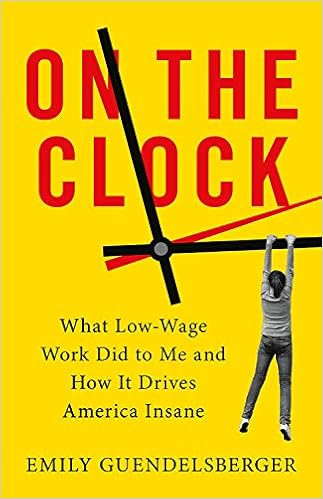
Book Review: On the Clock

Image result for On the Clock Guendelsberger

Emily Guendelsberger, On the Clock: What Low-Wage Work Did to Me and How it Drives America Insane

Ironically, Amazon* recommended this book to me. Ironic, because one of the jobs Guendelsberger works, and deconstructs, in this book is a job at an Amazon warehouse. I am now amused by the idea that Amazon warehouse workers are shipping her book out to people.

(I seldom buy books from Amazon. What I do is go over there and read their New Books page. Then I see if our library has whatever books look good, which it often does. But apparently I have bought enough books that Amazon now knows what sort of thing I like.)

Guendelsberger, who was laid off from her position as a journalist after her newspaper went out of business, spent what looks like a year or so working minimum or low-wage jobs around the country. The three jobs she examines in this book are


  • picker at Amazon
  • phone bank in a call center
  • counter at McDonalds
I worked several minimum wage jobs in high school and while I was getting my BA; but as Guendelsberger notes, that was then. Low-wage work in the 1980s and low-wage work in the second decade of the 21st century are two different propositions.

What changed low-wage work -- which was never pleasant, but is now destructive? A few things:

(1) The use of computers to analyze and set work schedules. This leads to people's work schedules being shifted constantly -- you never know when you're going to work, and you lose all ability to schedule your life outside of work.

(2) The idea of running a "lean" business. This -- the "lean" model -- means that managers will deliberately under-staff their places of business, so that everyone must work full-out every minute that they are on the job.

(3) "Taylorism," which is the efficiency model created by Frederick Taylor. Taylor is why so many jobs are so miserable today -- his model assumes that workers are morons, and also lazy thieves. So every workplace starts from that assumption, and managers end up treating workers as if they were lazy, stupid, and dishonest. 

(4) No benefits, including no sick days. Not just no paid sick days -- no sick days at all. If a worker calls in sick, they can count on being punished for it. (Because they're lying, right? Remember Taylorism.) There are some horrific examples of what this lack of benefits does to both workers and to the workplace. I won't give spoilers, but one word: MRSA.

This is an excellent book, both for the close look it takes at these three jobs, and for Guendelsberger's analysis of just why these jobs are so bad for people and for the country. 

For instance, she connects the crisis of opioid addiction to the fact that life as a low-wage worker (and something like half the country works low-wage jobs now) is so awful and so badly paid. When you are this stressed and this miserable, you will self-medicate. Some people do that by eating carbs; some do it by smoking; some do it with narcotics.

There's also a nice section on the economic benefits of this system -- the cui bono section.

Every few years, I teach a section on Working Class Literature at our university. Next time I do, this book is going on my list.

Highly recommended.


Friday, May 03, 2019

Reading Unwind, by Neal Shusterman


This is my next read-through, at the request of the Kid, who was compelled to read in it high school. This was one of the required texts in one of his English classes.

It purports to be a 'fair and balanced' response to the battle between Pro-Choice Americans and 'Pro-Life' Americans. In response to the 'Heartland War," the epigraph tells us, a 'Bill of Life' was passed.


To end the war, a set of constitutional amendments known as “The Bill of Life” was passed.  It satisfied both the Pro-life and the Pro-choice armies.   
The Bill of Life states that human life may not be touched from the moment of conception until a child reaches the age of thirteen.    
However, between the ages of thirteen and eighteen, a parent may choose to retroactively “abort” a child . . 

We are one page into this text and I am already saying Oh My God.

The 'Bill of Life' only makes sense if we assume (as apparently Shusterman did) that what pro-choice people really want to do is kill children.

Which, yeah, no. That's not what pro-choice people want, at all. They want the choice to be pregnant or not to be pregnant. And they want the risks and costs of the decision to be pregnant to be up to those who after all bear the physical dangers and costs of pregnancy. This 'Bill of Life' would do nothing about that.

Also, for fuck's sake, what "Pro-Life" person would be happy with killing children at 13? Even as annoying as most 13 year olds are. That's just beyond stupid.

Shusterman says people accept this because the 13 year olds don't 'really' die. Their body-parts and organs are transplanted into other people, so 'really' the children continue to live.

Again, in what universe would anyone find this argument acceptable?

But that's our premise. This novel already has a D- rating from me.

Chapter One

We meet Connor, who has discovered that his parents have sold him to the Unwinding... corporation? I don't know. It's not clear, at least so far, who runs the Unwinds.

Connor has been a trouble-making kid and young teen. He acted badly and mouthed off and refused to do well in school, even though he knew kids who acted that way were likely to be sold as Unwinds. Connor's kind of stupid, in other words, and terrible at planning ahead. True, he is thirteen. But still.

His parents are selling him off and using the money to go to Disneyworld with his younger, better behaved sibling. I'll admit I found this detail funny. I'm not sure Shusterman wanted us too, though.

Connor and his girlfriend decide to run away, except the girlfriend bails at the last minute.

Sulky, Conner runs on his own. He gets a lift from a sympathetic truck driver, who lost an arm in some early accident and now has an Unwind arm. The truck driver says the arm still had part of the dead teen's skills and personality (it can do card tricks) so he feels bad. That's why he helps.

Muscle memory is a thing, but I don't think it works like this. But whatever.

Just before they take off, Connor sees another teen get taken by the Unwind Police -- he was trying to run away too. But he draws attention away from Connor, in his noble way, and so Connor escapes in the truck.

He takes his phone with him, though. After his dad rats him out (boy, parents really hate their kid in this future world, I guess that's just how pro-choice people are, right?) the police track the phone, and the truck gets stopped.

I mean, this is realistic -- kids and their phones, amirite? -- but Connor has to be pretty stupid not to know he can be tracked by his phone.

The Unwind police are about to arrest him when Connor leaps the divide between two sides of the interstate (what?) and flees. At this point, between Connor's lack of foresight and his idiotic behavior, I'm really wondering if being Unwound wasn't his best possible future.

A car on the other side almost hits him, and crashes instead. Inside is a kid in white -- another Unwind! Connor pulls him from the wreck and they run off together.


Chapter Two

We meet another future Unwind, Risa. She's an orphan, living in Ohio State Home 23, and has been training in the orphanage to be a pianist. But she's just not quite good enough.

A little world-building here. Since contraception and abortion are now illegal, lots of parents surrender their extra kids at birth to the state. Some are adopted (storked, this is called). The rest end up in state custody, where they have to earn their right to survive past 13.

Risa hasn't. She's good at music, but not excellent. And 5% of the kids in the home have to be Unwound every year. This year, she's one of that 5%. She offers to change tracks -- she doesn't have to be a musician! She'll join the military instead!

Too late, her administrators tell her cheerily. Off she goes.

In the transport, she meets another Unwind, who seems happy about it. He knows he's a useless human being, he says, but this way part of him will go on to do something useful.

On the one hand, this makes sense -- the propaganda that must be fed to the kids in the home (excel or be unwound) might actual create this sort of resignation.

On the other hand, wow.

Then the bus they're in crashes into the pile-up Connor created by jumping across the interstate barrier, and Risa escapes.


Chapter Three

And...here's the creepiest chapter yet.

We meet a religious family. In this world, the 'Pro-Life' people now apparently make a religion out of bearing a lot of kids and 'tithing' one out of ten to the Unwind Centers. Apparently, all religious families do this now -- they have a ton of kids and designate one or more of them as their 'tithe.'

I'm guess for the money? I don't know. This doesn't make any sense. I don't care how much you believe in God, the notion that you'll send one out of ten kids to be slaughtered and call that 'Pro-Life' seems....

I was going to say unlikely, but then I remember the family in my neighborhood that was famous for not believing in birth control. They had twelve kids, which they could not afford (who can afford 12 kids?) and the three oldest joined the military in order to send money back and help the rest.

I mean, I don't know that those three died or even suffered injuries. But this was the era of the Vietnam war, so, yeah, kind of a tithe.

Lev is the tithe from his family. He's been raised from birth with the understanding that he's a special child, a sacrifice to God. Now that he's 13, and it's time to be Unwound, he's a little uncertain.

His preacher tells him that this is what God wants, and that he's the best of all his siblings, and that God wants the best. We find out that several of Lev's siblings are adopted (storked, as the novel puts it), because after all good Pro-life families all adopt lots of kids. And then send one of their own kids off to be Unwound.

Nevertheless, Lev is convinced, at least for now.

Lev, of course, is the kid that Connor rescues from the car.

Chapter Four

Lev objects to Connor's attempt to rescue him -- he's a tithe, God wants him to do this -- but the Unwind Cops are shooting at the three of them (Connor, Risa, and Lev) and Lev gets knocked out.

Connor shoulders him and he and Risa run for it.


Exasperated Thoughts:

So far this book fails the how-people-act test.

I'm not saying people don't surrender one or more children to help the other children in the family -- as I noted, a family in our neighborhood did just that. And I'm sure we can all think of families in which the oldest child works at terrible jobs to give the younger children a better advantage.

But there's a wide difference between that and selling your child to have its organs and other parts harvested.

Schusterman might think there's a parallel here, with some parents having abortions -- stopping a pregnancy because they can't afford another child, because that expense would harm the future of their family, including their already existing children.

Or someone at 16 having an abortion in order to finish school, giving themselves and their future children a better life.

Maybe that's the metaphor he's working with.

But there's a big difference between an abortion and killing your 13 year old.

Pretending this is exactly the same thing, either morally or ethically, is not just nonsense, it's the vile sort of lie we hear from 'Pro-life' people all the time. A blastocyst is the exact same thing as a toddler, so killing one is the same as killing the other.

No one believes that, not really. Or if they do, they're not someone I'd trust with a child anyway.

Also, Schusterman is ignoring the actual reason many people have abortions -- they don't want to be pregnant. Maybe they just don't want to be pregnant now; maybe they never want to be pregnant.

This is typical of the 'pro-life' crowd, obviously. Pregnancy isn't a disease! they declare. Childbirth is natural, they declare. It's only nine months, after all, and if you don't want they baby, why, you can just let some good Christian family adopt it.

Pregnancy kills over 700 people in America a year, and injures many, many others.

Pregnancy is a debilitating and miserable experience.

Yes, I know, some people love being pregnant. But for most of us, no, it's nausea and swelling feet and agonizing pain in our bones and ligaments, it's heart burn, it's the inability to take medication, some of which is vital for our health, it's a condition that causes permanent and sometimes debilitating changes to our bodies. It's not 'just nine months' of no big deal, and it's not over when we deliver, either.

And pregnancy creates a child which we are responsible for, forever. Giving that child up for adoption may seem easy to someone who had never birthed a child, but I could no more have given my child away than I could have sliced out my liver. It would have felt exactly the same.

The whole premise of this book, frankly, is something that only a person who could never be pregnant would have thought made any sense at all.

I'm going to keep reading, but jeez.


Saturday, February 23, 2019

Trigger Warning: Ch32 to End


Why does everyone hate Jake?

This is a question Jake asks himself after one of the terrorists, a back guy, speaks harshly to him.


“Don’t give me any trouble,” the gunman said as his lips drew back from his teeth in a grimace. “I’d just as soon shoot you, you son of a bitch.”  
That sounded personal, Jake thought. He wondered if the guy had a real reason to hate him, or if his skin color and political views were enough to justify that hatred.


Black people are the real bigots!

Also, the more I think about the big plot twist of Burke being part of the Bad Guys, the less it makes sense.

Did Matthias recruit her / get her hired at this university just in case he had some trouble-making guy he wanted her to woo? Or was that improvised, once they realized Jake, the Good Man with a Gun, was on campus?

If it's the latter, then why did he recruit Burke? Worse, why did she join his bizarre crime team? She doesn't seem to care about politics, and I refuse to believe anyone who is on the tenure track of an excellent university is silly enough to think his crime scheme had even the tiniest chance of success. Why blow up her life for something stupid like this?

I mean, obviously one point J.A. keeps harping on is that progressives, especially those who go to college, are stupid. And I know that's what lots of conservatives believe -- that we're just too stupid to understand Jesus, or what a gun does.

But Burke isn't written like she's stupid.

Also, if her job was to neutralize Jake, because Jake is such a threat to the Plan, then why doesn't she neutralize Jake?

She's been dating him for several days. She's been alone with him any number of times. He trusts her, apparently. I can think off the top of my head of six or seven things she could have done -- planted drugs on him, for instance, and called the police. Or planted child porn on him. Or not planted child on him and called the police to say he had child porn anyway -- that would have been enough to get him off campus, which is all they really need. Or told the campus police he has guns in his room. That would have gotten him expelled, which is -- again -- all they need.

Also! On the day of the big job, she literally invites him to the library. She makes sure he's in the library, where Matthias will be, when the Big Job kicks off. Why would she do that? Take him away for the weekend instead. Invite him away for a hot weekend in El Paso. I'm sure he would have gone.

This plot literally makes no sense.

Okay, let's wrap this up. We've got about 30% of the book left, but having skimmed through it, I have to warn you it gets really tedious.

Jake "McClane's" his way around the library, shooting people. Dr. Mtumbo joins forces with him, as does Pierce (or, as Jake calls them, 'a black Progressive and a Snowflake Professor.' I mean, good thing Jake doesn't filter everything through an ideological lens.) Neither has ever fired a gun before today, which amazes Jake. What world do these people come from, he wonders.

Um, the normal world?

Burke repents and tries to find Jake so she can apologize for being such a bad girl. She gets shot, but don't worry, she doesn't die.

But let's back up. About 75% of the way through the book, this new guy shows up. He's lean and tanned (Did I mention all the Good Guys with Guns in this book have deep tans? They do. Because cowboys, I guess.) though he's probably about 70, he moves "like a 22 year old athlete."

No fewer than three people comments on how Dog -- that's his code name -- moves like a 22 year old athlete. "He looks about 70," they will all say, "but he moves like a 22 year old athlete!"

'Dog' -- and he is constantly telling everyone to "Just call [him] Dog" -- moves through campus, shooting terrorists with preternatural skill. (One terrorist holds a woman in front of him, like a human shield, and Dog shoots him anyway, right through the mouth.)

How does he know who is a terrorist and who is not?

Because he's a Good Guy with a Gun, that's how.

Oh, and also the President has sent him here. That Trump. What a guy!

Also -- and this is the big surprise -- he's actually Jake's Uncle! (Plot twist!)

No wonder Jake is such a hero. He's genetically related to Dog.

Yes, Dog actually says this. Good genes create Good Guys with a Gun apparently.

This is also something I've noticed Conservatives believe -- that Certain People are Superior because they have Superior Genes. This is part of their White Nationalist bent, obviously. It's not their fault white people are the superior race -- it's just their genes. I mean, it's just science.

God, isn't this book over yet?

I'm leaving a lot out, such as for instance the redemption of that whiny Campus Cop who was evil because he was a progressive. He mans up and along with Jake shoots a bunch of people. Together, they free several hostages from the snack room in the library.

But of course the hostages are liberal snowflakes, and thus aren't grateful for being released.

“But . . . but is it safe?” asked a male undergrad with multiple piercings on ears, nose, and lips.  
A girl with pink hair said, “We should stay where we are until someone from the government tells us to leave.”

“The administration needs to issue a statement and address this,” added a middle-aged man who Jake pegged as a professor. “This campus is supposed to be a safe space and a gun-free zone.” He looked pointedly at the pistols Jake and Granderson held. “Neither of you should have those. You should turn them in!”

As a matter of fact, in our Mass Shooter training, the police told us very firmly that if we were holding a gun when they arrived, we would be shot. This is because, contrary to what this book claims, you can't actually tell a Good Guy with a Gun from a Bad Guy with a Gun.

Image result for Good Guy with a Gun cartoon


And that's something this book ignores -- how Dog knows the Bad Guys from the hostages; how Jake manages to shoot down any number of people without accidentally shooting a hostage; how, if Matthias had several people undercover in the library, as we're told he did, one of those 'hostages' Jake saved didn't turn out to be one of them, so that Jake got shot in the back.

How in real life shoot-outs don't work even remotely the way they do in this book.

In the final chapters, for instance, Jake and Matthias shoot each other. Matthias dies. Jake, who had taken three slugs to the chest, spends a few weeks in the hospital and then is just fine.

Yeah, no. That's not what happens when you get shot multiple times in the chest.

Okay, I'm leaving a lot out -- for instance, the FBI show up about 70% of the way through the book, but they don't do anything except get in the way of Dog and the Chief of Campus police. Because the government is useless, obviously. Only Good Men can do anything.

And yes, it has to be men. We have two women in this book. One, Burke, is an inept traitor, and the other is a Homeland Security official, and a total bitch who hates men.

Most of these last chapters are taken up in describing the fights Jake has with people. Pages and pages of detailed descriptions of these fights, all really boring.

But in the end, Jake and Dog take down the evil progressive terrorists, and the hostages (well, most of them) are saved.

Of course, the university students all need counseling, because "that was the trouble with being a snowflake. You melted if it got the least bit warm."

See, only snowflakes would have PTSD after something like this, or need counseling. Jake, the Real Man, just shrugs it off.

Then his uncle offers him a job, being his partner.

"Work for the government?" Jake frowns.

Because governments are evil, remember.

But don't worry. Dog is a freelance Good Guy with a Gun. So Jake doesn't have to stick his snout in the government trough.

Whew! Close one.

The End

We never find out what happened to Pierce, in case you were wondering, or why Burke is a part of Matthias's crew. We do find out Burke gets arrested, after Jake saves the day, but not what happens to her after that -- does she get the death penalty?

I mean, this is Texas, and Matthias is responsible for more than 30 deaths. Given she's his accomplice, she's on the hook for all those deaths.

Also, what about the big crush Jake had on her? How he was willing to risk his life for her? And then she's a Bad Guy with a Gun? (Also, if Jake is so good at telling Good Guys from Bad Guys, why doesn't he figure out Burke is a bad guy before she has a literal gun shoved in his ribs?)

But this doesn't disturb Jake at all. He just shrugs it off. Bitches, what can you do?

Over on Amazon, the MAGA Americans writing reviews of this book are begging for a sequel. I imagine J.A. will give them one.  Anything for money, after all.