

1 day ago

Wednesday, August 14, 2019
Worldcon
My people are in Dublin this week. More here. And here.
I'm usually too broke to go to SF workshops or conventions, but I love watching them from afar.


Links
This is wonderful (stolen from N&M)
Huh
MAGA Americans love to complain about the hellscape of SF, but
This makes a good point about why the Right is so susceptible to scams
Who said it?
The actual hellscape
The Party of Personal Responsibility, where it's always someone else's fault
The sixth leading cause of death for US men ages 20 to 26
In light of which, this is interesting -- we lose more people to guns than to cars, and more to drug addiction than to guns
Guess who paid for the huuuge tax break. Yeah, that would be people like me. Meanwhile, ‘Those in the top 1%... got an average tax cut of about $33,000’
I remember the glee that surrounded these liars when they broke their scam


Tuesday, August 13, 2019
Back to School
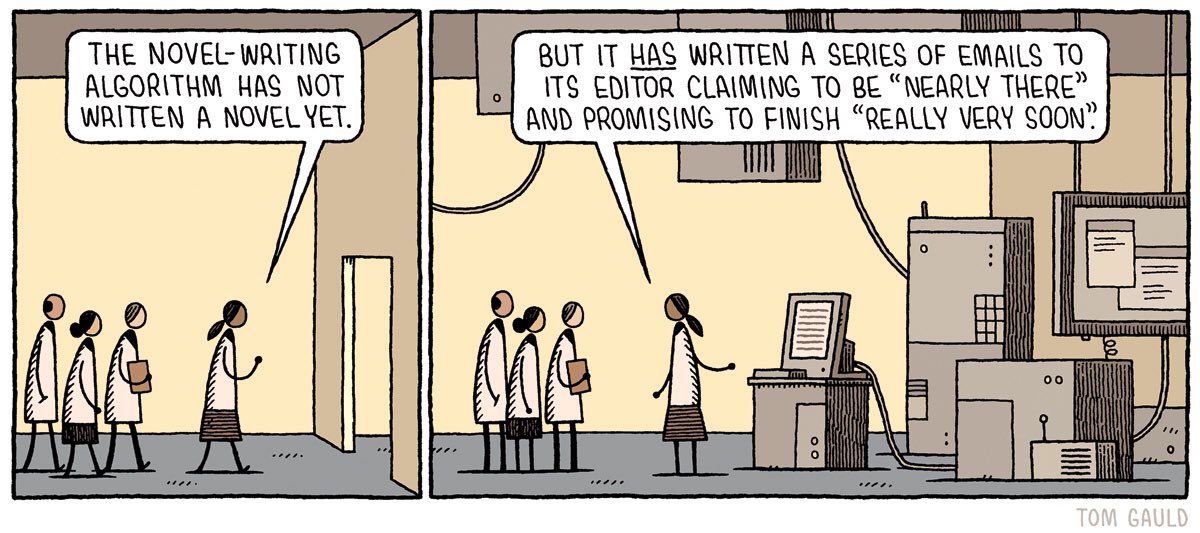
Thursday and Friday are our pre-school conferences, and Monday my first day of classes. I had the entire summer to write, since none of my classes made, and I still didn't get as much done as I wanted to.
Here's for getting more done this winter.
Monday, August 12, 2019
My Hometown
This is the sort of crime that happens in my hometown:
Man Run over by Cow On Garrison Avenue Bridge
A man was run over by a cow according to the FSFD Battalion Chief Terry Graves and the incident happened before 11 a.m.
Now with video!
https://www.facebook.com/tori.keith.9/posts/2482631451816688
Sunday, August 11, 2019
What I'm Reading Now: UPDATED
Yuval Noah Harari, Sapiens: A Brief History of Humankind
Non-fiction, but very readable. Harari starts from the big bang and moves forward. His overarching theme is that fiction -- myths, religion, laws, corporations, nations -- made it possible for humankind to become the dominant animal on the planet, by allowing us to move past the small band stage of organization. An example is religion. When we can all identify as Catholics, then we all know what rules we order our world by, and we can thus cooperate with total strangers, in a way we can't without those rules. Same for, say, governments. When we identify as US Citizens, we have a set of rules we all agree on, and then we can cooperate with total strangers.
This ability to make up rules about the world, and then believe that those rules are real (instead of just made up by us), Harari argues, is our great power. His argument is compelling.
Of course you see the problem. We identify as US Citizens, but do we agree on the set of rules? Right now we are vehemently disagreeing, because the set of rules is changing. Harari notes this is also something humans can do -- change their rules radically and abruptly. (Cf the French Revolution, when we went from the Divine Right of Kings to the Sovereign Rule of the People.)
Very much a must-read, just for this insight alone.
ETA: Boy, did this book go downhill fast after that chapter.
I'd read about 60% of it at that point. After that, I hit the chapters on religion and science, in which Harari argues that science functions as religion, or at least serves the same purpose as religion. I might have gone along with him, since his basic point is that science, like religion, allows people to cooperate and work together. But his argument in these chapters shows that he fundamentally misunderstands how science works, and what science is. For instance, he argues that evolution -- and evolutionary science -- is about evolving into superior creatures; or devolving into inferior beings.
Now it is true that Social Darwinists act as though this is what evolution means -- that evolution has a teleology, and that this is that teleology, the creation of some Better Human (that's why many people in the USA today want a "certain" sort of person to reproduce, and other sorts not to do so).
But that is not what actual evolutionary science is about. Evolution has no aim. There is no "superior" or "better" creature in evolution. There's a creature that is fit for the environment that exists right now, which is the one that survives. No moral element to that fitness. And there is certainly no "devolving" in evolution. The very notion is an oxymoron.
So at that point, I'm afraid, I lost all confidence in Harari as a scholar, and when I looked around to see what other reviewers said, it seems he has made similar errors in basic facts in other places.
Although I still like what he said in the first half of the book, I can no longer trust him, and no longer recommend this book.
Non-fiction, but very readable. Harari starts from the big bang and moves forward. His overarching theme is that fiction -- myths, religion, laws, corporations, nations -- made it possible for humankind to become the dominant animal on the planet, by allowing us to move past the small band stage of organization. An example is religion. When we can all identify as Catholics, then we all know what rules we order our world by, and we can thus cooperate with total strangers, in a way we can't without those rules. Same for, say, governments. When we identify as US Citizens, we have a set of rules we all agree on, and then we can cooperate with total strangers.
This ability to make up rules about the world, and then believe that those rules are real (instead of just made up by us), Harari argues, is our great power. His argument is compelling.
Of course you see the problem. We identify as US Citizens, but do we agree on the set of rules? Right now we are vehemently disagreeing, because the set of rules is changing. Harari notes this is also something humans can do -- change their rules radically and abruptly. (Cf the French Revolution, when we went from the Divine Right of Kings to the Sovereign Rule of the People.)
Very much a must-read, just for this insight alone.
ETA: Boy, did this book go downhill fast after that chapter.
I'd read about 60% of it at that point. After that, I hit the chapters on religion and science, in which Harari argues that science functions as religion, or at least serves the same purpose as religion. I might have gone along with him, since his basic point is that science, like religion, allows people to cooperate and work together. But his argument in these chapters shows that he fundamentally misunderstands how science works, and what science is. For instance, he argues that evolution -- and evolutionary science -- is about evolving into superior creatures; or devolving into inferior beings.
Now it is true that Social Darwinists act as though this is what evolution means -- that evolution has a teleology, and that this is that teleology, the creation of some Better Human (that's why many people in the USA today want a "certain" sort of person to reproduce, and other sorts not to do so).
But that is not what actual evolutionary science is about. Evolution has no aim. There is no "superior" or "better" creature in evolution. There's a creature that is fit for the environment that exists right now, which is the one that survives. No moral element to that fitness. And there is certainly no "devolving" in evolution. The very notion is an oxymoron.
So at that point, I'm afraid, I lost all confidence in Harari as a scholar, and when I looked around to see what other reviewers said, it seems he has made similar errors in basic facts in other places.
Although I still like what he said in the first half of the book, I can no longer trust him, and no longer recommend this book.
Friday, August 09, 2019
Whaaat!
Quillette isn't a reliable source? No!
Quillette: the truth is whatever confirms my views pic.twitter.com/NLU7uINw4N— Ted McCormick (@mccormick_ted) August 9, 2019
Thursday, August 08, 2019
Links
This thread is great
This went hog wild last week
Americans think their country is #1, but
For this one, you have to read the comments -- there really is no bottom here
cop: do you know why i pulled you over— rocket (@tweetsbyrocket) August 6, 2019
me: because the police force is a fascist institution designed to protect the wealthy
cop: there's a man in your trunk
me: yea a 𝙧𝙞𝙘𝙝 man
Wednesday, August 07, 2019
Whining
It's going to be 101 degrees here today, with a heat index of 113.
Also, through no fault of my own -- a clerical error on the other end -- I did not get my sabbatical. Aargh.
I've been invited to reapply, at least.
Tuesday, August 06, 2019
What I'm Reading Now

Non-fiction, but very readable. Harari starts from the big bang and moves forward. His overarching theme is that fiction -- myths, religion, laws, corporations, nations -- made it possible for humankind to become the dominant animal on the planet, by allowing us to move past the small band stage of organization. An example is religion. When we can all identify as Catholics, then we all know what rules we order our world by, and we can thus cooperate with total strangers, in a way we can't without those rules. Same for, say, governments. When we identify as US Citizens, we have a set of rules we all agree on, and then we can cooperate with total strangers.
This ability to make up rules about the world, and then believe that those rules are real (instead of just made up by us), Harari argues, is our great power. His argument is compelling.
Of course you see the problem. We identify as US Citizens, but do we agree on the set of rules? Right now we are vehemently disagreeing, because the set of rules is changing. Harari notes this is also something humans can do -- change their rules radically and abruptly. (Cf the French Revolution, when we went from the Divine Right of Kings to the Sovereign Rule of the People.)
Very much a must-read, just for this insight alone.
ETA: Boy, did this book go downhill fast after that chapter.
I'd read about 60% of it at that point. After that, I hit the chapters on religion and science, in which Harari argues that science functions as religion, or at least serves the same purpose as religion. I might have gone along with him, since his basic point is that science, like religion, allows people to cooperate and work together. But his argument in these chapters shows that he fundamentally misunderstands how science works, and what science is. For instance, he argues that evolution -- and evolutionary science -- is about evolving into superior creatures; or devolving into inferior beings.
Now it is true that Social Darwinists act as though this is what evolution means -- that evolution has a teleology, and that this is that teleology, the creation of some Better Human (that's why many people in the USA today want a "certain" sort of person to reproduce, and other sorts not to do so).
But that is not what actual evolutionary science is about. Evolution has no aim. There is no "superior" or "better" creature in evolution. There's a creature that is fit for the environment that exists right now, which is the one that survives. No moral element to that fitness. And there is certainly no "devolving" in evolution. The very notion is an oxymoron.
So at that point, I'm afraid, I lost all confidence in Harari as a scholar, and when I looked around to see what other reviewers said, it seems he has made similar errors in basic facts in other places.
Although I still like what he said in the first half of the book, I can no longer trust him, and no longer recommend this book.
Erika Swyler, Light from Other Stars

I'm not sure I like this one, but I did read it straight through. The first half is better than the second half.
It's about a young girl, Nedda Pappas, who becomes an astronaut, and also about a town caught in a time-loop-sort-of-thing. The book moves back and forth from a few days in Nedda's childhood in her Florida town to a few days in Nedda's adulthood.
In her childhood, she witnesses the Challenger explosion and then deals with the outfall of her father's scientific breakthrough, one which does very odd things to time as the town experiences it. In her adult life, she's on a space ship, traveling away from Earth toward a possible colony planet.
The first half of the book is very readable and compelling. The second half is less so, but I still read it. I'd say a B+.
Sarah Blake, The Guest Book, The Postmistress
These are historical fiction / Romance / mystery novels. Both are set in WWII, and both are compulsively readable. The Guest Book is a better book than the Postmistress, but both are pretty good.
They're both the sort of big sprawling book I like a lot -- like Middlemarch and Nobody's Fool -- where the author writes about a community, rather than an individual, using the community to show how the individuals happen, and how and why the individuals make mistakes. Blake does a really good job with this in The Guest Book especially.
The Guest Book is the story of a wealthy East Coast family, a very nice family, one that ends up doing some appalling things. The Postmistress is the story of a small coastal town in Massachusetts during WWII, and the intertwined lives of several families there, including one woman whose husband goes off to serve as a doctor during the Blitz, and the postmistress of the town, and a reporter who works with Edward Murrow.
Highly recommended. Blake has written one other book, but I do not recommend that one.
Richard Russo, Chances Are
You know I'll read anything Russo writes. This is not as good as Nobody's Fool, which is my favorite Russo novel, but it's better than his last few books have been.
Three men in their mid-sixties meet for a weekend at a summer house in Martha's Vineyard which one of them has inherited. They've been friends since their college days, when they spent a similar weekend here. That's the weekend that the young woman they all loved disappeared.
So we have another mystery/romance/historical novel, sort of, and also a novel of an intertwined community. This one is set (the part about the sixty-ish men) in the summer of 2016, just before Trump's election, so we get some commentary on that. The other part (the college days) is set in 1970, in the last years of the Vietnam war, so we get some details on that.
It's readable, because everything Russo writes is readable, but I don't know that it ever takes fire the way Nobody's Fool does.
On the other hand, Nobody's Fool is a perfect book. It's probably unfair to complain that Russo hasn't written yet another perfect book, that loser.
Monday, August 05, 2019
What Does the Right Say?
The Right says young white men murdering people in mass quantities is the fault of the Left -- because we're pro-choice, which teaches young men that killing is okay.
The Right says it's because young white men are "bullied" in school.
The Right says it's because of video games.
The Right says it's because young men are "devalued" in society.
The Right says it's because young women won't date these specific young men.
The Right says it's because "family" has been "corrupted" (I bet you can guess by who).
The Right says it's because women have jobs.
The Right says it's because immigrants have robbed young white men of the belief that their culture (the culture where all Americans are white men) is the culture of America.
The Right says it's because of cell phones.
The Right says it's because of feminists.
The Right says it's because of public schools.
The Right says it's because of Satan.
The Right says it's because of the Left.
The Right says it's because of porn.
I mean, guns don't shoot people. Porn shoots people.
It’s not Trump’s fault. It’s not the NRA’s fault. When will our nation wake up and realize we have a youth mental health crisis likely caused by over-medication, absentee parents, and a culture that glorifies infamy and notoriety above God, family and community?— Tomi Lahren (@TomiLahren) August 4, 2019
Studies show millennial/young men are the loneliest generation (high rate of having zero friends or no close friends), skyrocketing rates of suicide, by far most violent demographic in America. Not a group that garners a ton of sympathy in the media but problem demands inquiry.— Lee Fang (@lhfang) August 5, 2019

Sunday, August 04, 2019
Mass Shooters
Who radicalized him?

Original link here:
Using the El Paso terrorist's manifesto, I connected the dots for folks still having trouble doing that.— Brandon Friedman (@BFriedmanDC) August 4, 2019
This is just the first page. pic.twitter.com/mQcW3doGNF
Thread
Two mass shootings in two days, both by white males who have been radicalized by Trump and by white supremacists.
Thread:
https://twitter.com/LOLGOP/status/1158027069269450752


Saturday, August 03, 2019
Links
New books
Via Heebie at Unfogged, this unsurprising story (I still remember all the guys who would get so angry when I outscored them on exams as an undergrad -- including, btw, my own brother)
Good thing we put this dishonest hack on the Supreme Court. (In case you're stopped by the paywall, it's yet another series in the fantasy genre, where conservatives who haven't been on a university campus in 30 years tell us about those colleges, based on what they've seen on Fox News.)
Not sure what's more disturbing here -- the actual commercial or the comments from YouTube viewers:
 |
| I just..what? |
 |
| Also it made me think of this, though I don't know why |
Thursday, August 01, 2019
July Temperatures
Image stolen from Camestros, over here

Anyone running for office who isn't talking about this doesn't get my vote.
Subscribe to:
Posts (Atom)